A Complete Guide to Quality Leather Belt Manufacturing
- Share
- publisher
- Hongmioo
- Issue Time
- Jul 7,2026
Summary
Learn how quality leather belts are made, from material selection and cutting to edge finishing, stitching, hardware assembly and final inspection.
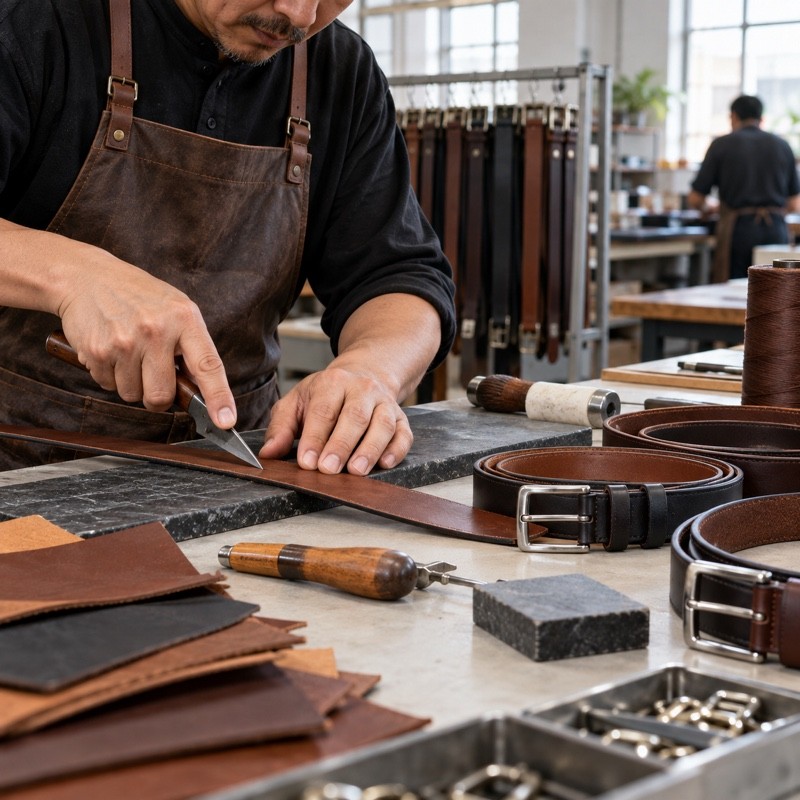
Leather belts remain one of the most enduring accessories in men's and women's fashion. Their manufacturing process is a blend of traditional craftsmanship and modern quality control that determines the final product's durability, appearance, and value. For brands looking to source custom leather belts, understanding this process is essential for specifying the right materials and construction methods. The quality of a leather belt begins with the specified material and construction. Full-grain retains the natural grain and may develop patina with wear. Top-grain is commonly corrected and finished for a more uniform surface. The term genuine leather does not by itself identify a grade or construction, so ask for the leather type, thickness, backing and surface treatment rather than relying on the label alone. For belt manufacturing, leather thickness typically ranges from 3.0 mm to 4.5 mm depending on the belt style and intended use. Dress belts often use thinner, more flexible leather, while work and tactical belts require thicker, stiffer hides. A defined manufacturing process helps buyer and supplier agree the construction and approval points for the selected belt: Leather strips are cut to the required width and length. The cutting plan should account for usable hide areas, material variation and the thickness specified for the belt. The buckle-end of the belt is thinned (skived) to allow the leather to fold smoothly around the buckle, preventing bulkiness at the attachment point. Raw edges are beveled, sanded, and painted or burnished to create a smooth, professional finish that resists fraying and wear. Machine or hand stitching can be used according to the design. Agree stitch spacing, thread, reinforcement points and finished seam appearance on the sample. Buckles, rivets and keeper loops are attached. Specify hardware material, finish and attachment method, then check operation and appearance on the assembled sample. The belt receives its final conditioning treatment and is inspected for stitching consistency, edge quality, buckle alignment, and overall appearance before packaging. When evaluating leather belt samples from manufacturers, pay attention to these key quality indicators: Hongmioo was established in 2012, with belt-making experience dating to 1998. Explore the leather belt collection, then send the intended use, material specification and quality criteria for a product-specific quotation and sample plan. Quality leather belt manufacturing is the result of careful material selection, skilled craftsmanship, and rigorous quality control. By understanding the process and knowing what quality indicators to evaluate, brands can confidently select a manufacturing partner that will produce belts meeting their specifications and delighting their customers.A Complete Guide to Quality Leather Belt Manufacturing
Leather Grades and Selection
The Manufacturing Process
Step 1: Cutting
Step 2: Skiving
Step 3: Edge Finishing
Step 4: Stitching
Step 5: Hardware Attachment
Step 6: Final Finishing
Quality Indicators to Look For