Custom Belt Collection Planning for Brands: Materials, Buckles and Positioning
- Share
- publisher
- Bryan
- Issue Time
- Dec 15,2024
Summary
A practical guide for brands planning a custom belt collection, covering market positioning, materials, buckle development, assortment and production.
Custom Belt Collection Planning for Brands: Materials, Buckles and Positioning
A strong custom belt collection begins with a clear customer, price position and use case. Instead of developing isolated styles, brands can improve sell-through and sourcing efficiency by planning materials, buckles, colors and sizes as one coordinated program.
Define the customer and price tier
Start with the wearer, sales channel and expected retail price. A premium department-store collection may justify top-grain leather, custom hardware and refined packaging. A volume fashion program may prioritize consistent PU, efficient buckle tooling and tightly controlled color standards. Golf, workwear, uniform and promotional belts each require different performance features.
Build a practical material architecture
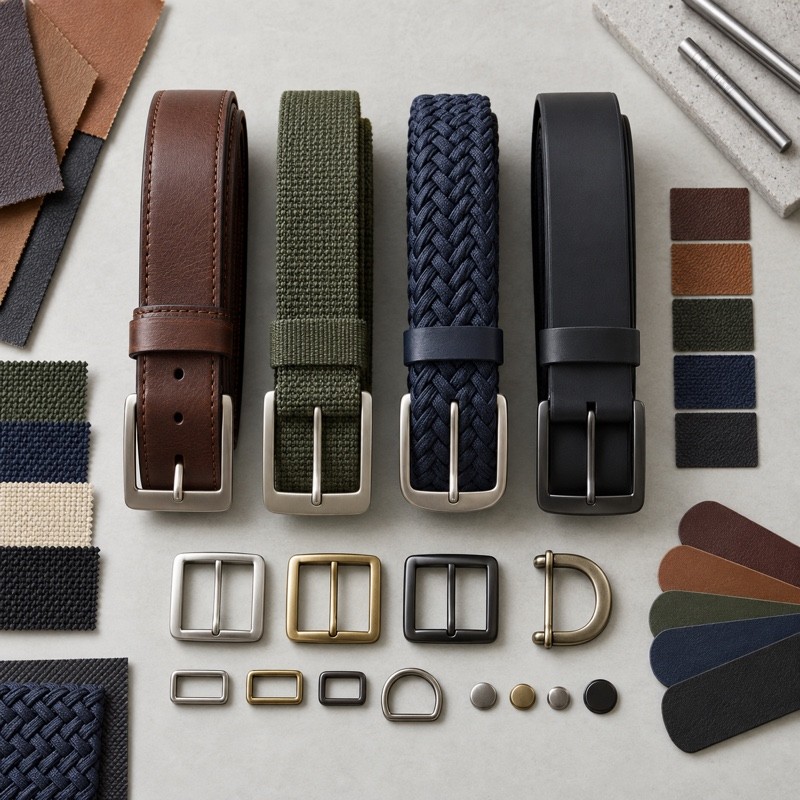
Use a small number of proven base materials across several styles. Genuine leather adds structure, longevity and a premium feel. PU provides repeatable color, texture and cost control. Elastic and webbing constructions offer comfort and flexibility for casual, outdoor and sports collections. Shared materials can reduce development time and simplify repeat orders.
Treat the buckle as a brand asset
The buckle often provides the strongest visual identity. Buyers should specify shape, size, weight, plating color, logo position and opening method. Existing buckle molds can shorten development and reduce tooling cost, while a custom buckle creates stronger differentiation. Salt-spray resistance, plating adhesion and operating cycles should be checked for the intended market.
Plan a disciplined assortment
A commercially useful range normally combines core colors with a few seasonal options. Black, dark brown, tan and navy can anchor repeat sales, while selected accent colors or textures add freshness. Keep widths and buckle families consistent enough for visual cohesion. Confirm the size range, hole spacing and labeling system before sampling.
Approve against measurable standards
Review samples for dimensions, shade, edge finish, stitching, buckle function, logo position, packaging and wear performance. Provide annotated feedback and retain an approved reference sample. A written specification sheet helps keep later production consistent.
Develop with Hongmioo
Hangzhou Hongmioo Industrial Co., Ltd. was established in 2012. Our belt-making experience dates back to 1998. We support private-label belt programs from material and buckle selection through sampling, production, inspection and packaging.
Samples typically take 10–15 days after specifications and materials are confirmed. Bulk production is usually about 35 days after sample approval, subject to quantity and customization. Browse our custom belt categories or contact us with your collection brief.